
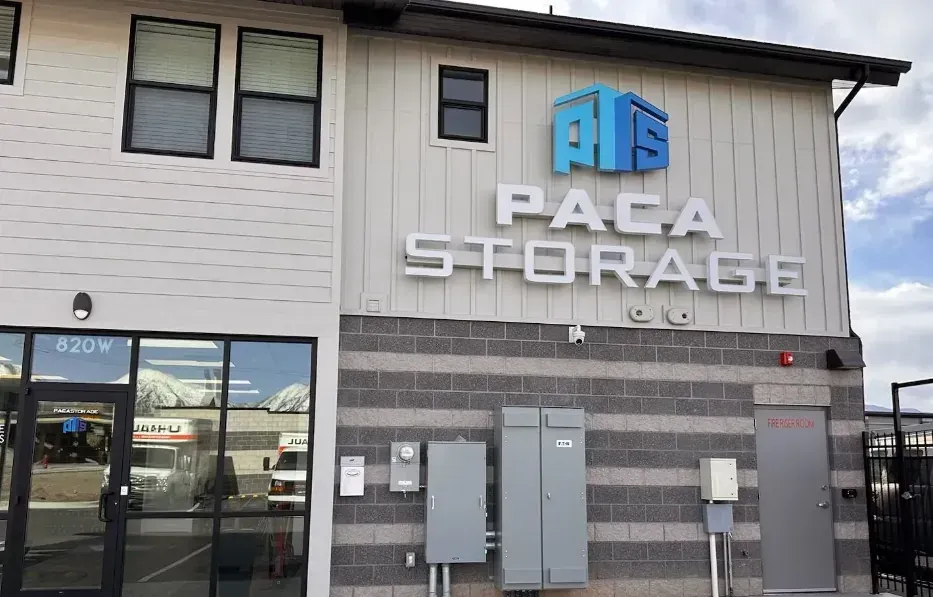
Drive-Up Storage Units in Payson, Utah
Back the truck to the door, roll it up, and you're loading. No corridors, no elevators, no carrying a dresser forty feet across a warehouse floor.
A drive-up storage unit is the one with a roll-up door you can park a vehicle directly in front of. That's the entire difference, and it sounds minor until you've done it both ways. The gap between a drive-up unit and an interior one isn't measured in dollars — it's measured in how many trips you're willing to make before you start leaving things in your garage instead.
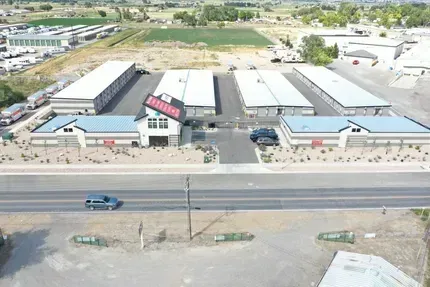
Search for drive up storage units Payson Utah and you'll find plenty of listings that use the phrase loosely — an exterior unit with a door near a road is not the same as a unit you can reverse a truck to. PACA Self Storage offers genuine drive-up access in three sizes at our Payson facility, from $125 a month, on a property that's paved end to end with aisles wide enough to maneuver a 26-foot truck. If you'll be in and out of your unit regularly — and especially if you're moving a household or running a trade — this is almost certainly the format you want.
What Drive-Up Access Actually Changes
An interior unit sits inside a building. You park, unload onto a cart or your shoulder, cross the lot, get through a door, go down a corridor, and arrive. Then you do it again. And again. A drive-up unit removes every step between the tailgate and the threshold.
Put numbers on it, because the numbers are the argument. Say the walk from a parking spot to an interior unit is 40 yards each way — a conservative estimate in a building of any size. Add door handling and a cart, and you're at roughly two minutes per round trip. A one-bedroom move is somewhere around 40 trips. That's 80 minutes of walking before you've lifted anything you didn't have to.
With a drive-up unit those trips are a few steps each. The same move drops to a fraction of the time, and the fatigue difference is larger than the clock difference — the last ten trips of a move are the ones where things get dropped, corners get scraped, and people get hurt.
That math changes the calculation entirely if you're not moving once but visiting constantly. A contractor pulling tools three mornings a week isn't making 40 trips; they're making 400 a year. At that frequency, an interior unit quietly costs a working week.
The honest counterpoint: a drive-up unit's door opens to the outside, so it's exposed to the weather every time you use it, and it isn't the right home for anything temperature-sensitive stored long-term. If that's your situation, read climate-controlled storage in Payson first — we'd rather you rent the right unit than the convenient one.
Who Drive-Up Units Are Really For
Frequency is the deciding variable. The more often you'll open the door, the more the format pays for itself — and past a certain point the alternative stops being practical at all.
Contractors and trades
The single most common drive-up tenant in south Utah County. Pull up at 5 a.m., load what the job needs, drop it back after dark. With 24/7 gate access nobody is waiting for an office to open, and heavy or awkward equipment never has to go through a doorway. See also business storage.
Households in the middle of a move
Moving is the one time nearly everyone benefits, because it's the one time you're handling every object you own inside a fixed window. Drive-up turns a two-day job into a one-day job more often than not.
Anyone storing something heavy
Appliances, workbenches, tool chests, safes, riding mowers, motorcycles, gym equipment. If it takes two people and a dolly, it should not also take a corridor.
Seasonal rotation
Ski gear out in November and back in April, camping gear out in May, holiday decorations twice a year. Half a dozen swaps a year is enough for the format to earn its keep.
Small businesses with moving inventory
Event and rental companies, landscapers, market vendors, trades with stock. If a van needs loading and unloading on a schedule, drive-up is the only sane arrangement.
Drive-Up Sizes and Rates in Payson
We offer drive-up access in three sizes — the ones people actually need it for. Smaller units are interior, because a 5x5 rarely holds anything you'd struggle to carry.
| Size | Roughly Holds | Typical Tenant | Rate |
|---|---|---|---|
| 10' × 10' | One-bedroom apartment with appliances | Garage cleanout, first move | $125/mo |
| 10' × 15' | Two-bedroom home, plus tools and gear | Contractors, growing households | $143/mo |
| 10' × 20' | Three-bedroom home, or a vehicle plus boxes | Full moves, trades, businesses | $174/mo |
Across the drive up storage units Payson Utah renters actually have to choose between, the premium is small: ours runs about $10 more per month than an interior unit of the same size — $125 against $115 for a 10x10, $174 against $164 for a 10x20. Set that against 80 minutes of walking on a single move and it stops being a real decision.
Every rate on this page is month-to-month with no long-term lease. The complete table across all seventeen unit configurations is on our storage units in Payson, Utah page.
Drive-Up, Interior, or Climate-Controlled?
These aren't competing products so much as answers to different questions. Here's the honest comparison at 10x10, so the numbers are directly matched.
| Drive-Up | Interior | Climate-Controlled | |
|---|---|---|---|
| 10x10 rate | $125/mo | $115/mo | $135/mo |
| Load time | Fastest | Slower — corridor carry | Slower — corridor carry |
| Heavy or bulky items | Best | Awkward | Awkward |
| Temperature stability | Tracks outside | Somewhat buffered | Conditioned year-round |
| Weather at the door | Exposed when open | Sheltered | Sheltered |
| Best for | Frequent access, tools, moves | Budget, medium-term, lighter goods | Wood, leather, paper, electronics |
Plenty of customers rent two: a drive-up unit for the tools and the bulk, and a smaller climate-controlled unit for the things that would be damaged by a Utah summer. Two right-sized units frequently cost less than one oversized one, and everything ends up where it belongs.
Drive-up units from $125/mo
Month-to-month, paved throughout, with 24/7 keycode gate access.
How to Lay Out a Drive-Up Unit
Drive-up access saves you nothing if the thing you need is behind everything else. A unit you'll open weekly has to be organized differently from one you'll open twice a year.
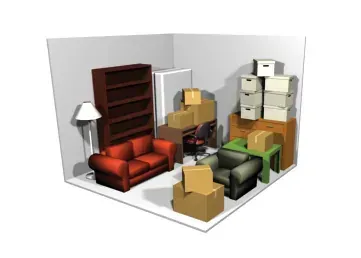
- Leave a center aisle. Non-negotiable for a unit you use regularly. Pack to both side walls and keep a walking lane down the middle so the back is always reachable without unloading the front.
- Zone by frequency, not by category. Everything you touch weekly goes in the front third. Everything seasonal goes in the middle. Everything you're merely keeping goes at the back. This beats organizing by room every time.
- Add shelving on one wall. Freestanding metal shelving turns dead vertical space into accessible space, and it stops small items being buried under boxes. For a tool or inventory unit it's the single best upgrade you can make.
- Heaviest items on the floor along the walls, lighter boxes stacked on top. Never stack heavy on upholstered furniture.
- Label two sides of every box — the front and the top. You'll be reading them at different angles depending on how they're stacked.
- Keep everything off the concrete. Pallets, 2x4s, or a base layer of plastic totes. Cheap insurance against any spill or seep reaching your cardboard.
- Don't block the door track. Leave a clear foot inside the roll-up so nothing fouls the door or falls out when you open it.
If you're rotating stock or tools rather than storing a household, treat the unit as a small workspace: shelving down one side, aisle down the middle, staging area just inside the door. It's the difference between a unit you use and a unit you dread.
Loading Day: What to Expect on Site
A few practicalities specific to using a drive-up unit here:
- Getting in. We're a minute off I-15 Exit 250 on a wide commercial road — no downtown routing and no tight residential turns with a trailer behind you. Full directions on our storage units near me page.
- Maneuvering. The aisles are sized so you can turn and back a 26-foot truck to a door without a spotter.
- Surface. Paved end to end. No gravel, so no mud in March and no dust in July tracked into the unit.
- Truck rental. We're an authorized U-Haul dealer, so the truck and the unit come from one address instead of two trips. See U-Haul truck rental in Payson.
- Supplies. Boxes, tape and protective material are in the office, so a forgotten roll of tape doesn't cost you a hardware-store run mid-load. See moving supplies.
- Timing. Move in during office hours, Monday to Saturday 9:30 a.m. to 6:00 p.m., so the manager can walk you to the unit. After that your gate code works around the clock.
- Weather. Because the door opens outside, keep a tarp in the truck for a wet or snowy load day. Anything going into a unit must go in dry regardless of format.
Location
PACA Self Storage
820 W Utah Ave
Payson, UT 84651
Phone
Office Hours
Monday–Saturday
9:30 a.m.–6:00 p.m.
Closed Sunday
Gate Access
24 hours a day, 7 days a week
for all tenants, with a personal keycode
Drive-Up Storage FAQs
What is a drive-up storage unit?
A drive-up unit is a ground-floor unit with a roll-up door opening directly onto a drive aisle, so you can park a car, truck or trailer immediately in front of it and load straight from the vehicle. There's no shared corridor, no elevator, and no carry across a parking lot — the difference is the distance between your tailgate and your belongings.
Can I back a moving truck right up to the door?
Yes. Our drive aisles are paved and sized so you can turn and reverse a 26-foot truck up to a unit door without a spotter. The approach from I-15 Exit 250 is a wide commercial road, so there are no tight turns to negotiate on the way in either.
Do drive-up units cost more than interior units?
Slightly. At our Payson facility drive-up runs about $10 a month more than an interior unit of the same size — $125 versus $115 for a 10x10, $143 versus $133 for a 10x15, and $174 versus $164 for a 10x20. For anyone loading or unloading more than once, the time saved is worth considerably more than the difference.
What sizes are available with drive-up access?
We offer drive-up in 10x10 ($125/mo), 10x15 ($143/mo) and 10x20 ($174/mo). Smaller units are interior, since a 5x5 or 5x10 rarely holds anything you'd struggle to carry. If you need a small unit and frequent access, a 10x10 drive-up is usually the better buy.
Are drive-up units heated or air conditioned?
No. Drive-up units open to the outside and are not conditioned, so the interior tracks the outside temperature. That's fine for tools, equipment, hard goods and short-term household storage. For wood furniture, leather, electronics, documents or anything stored long-term, choose a climate-controlled unit instead — those are air conditioned in summer and heated in winter.
Can I use a drive-up unit for my business?
Yes, and many of our tenants do — contractors, tradespeople, landscapers, event and rental companies, and small retailers with seasonal stock. Drive-up access plus a 24/7 gate code means loading a van at 5 a.m. is straightforward. Note that a storage unit is for storage: you can load, unload and organize, but units aren't set up as workshops or retail space.
Can I park a car or motorcycle inside a drive-up unit?
A motorcycle or small vehicle fits comfortably in a 10x20, and it's a common arrangement for classic cars and seasonal bikes. Current registration and insurance are required, and fuel tanks should be low. For anything larger — RVs, boats, trailers — outdoor parking spaces from $65 a month are the better and cheaper option.
Are drive-up units as secure as interior ones?
Every unit on the property sits behind the same perimeter fencing, keycode-controlled gate, camera coverage, lighting and on-site manager. Interior units add a building as one extra layer, so if you're storing something exceptionally valuable that's worth weighing. For tools, equipment and household goods, a drive-up unit with your own quality lock is well protected.
Are the drive aisles cleared in winter?
The property is fully paved rather than gravel, which makes a real difference in a Utah January — paved surfaces clear properly and don't turn to mud during a thaw. Combined with lighting across the site, a drive-up unit stays usable through winter rather than becoming a place you avoid until spring.
How should I organize a drive-up unit I'll visit often?
Leave a center aisle and pack to both side walls, then zone by how often you need things rather than by which room they came from: weekly items in the front third, seasonal in the middle, long-term at the back. Add freestanding shelving down one wall to make vertical space usable, keep everything off the concrete on pallets or totes, and leave a clear foot inside the door so nothing fouls the roll-up track.
Back up, roll up, done
Drive-up storage units in Payson from $125/mo, month-to-month, 24/7 access.





