
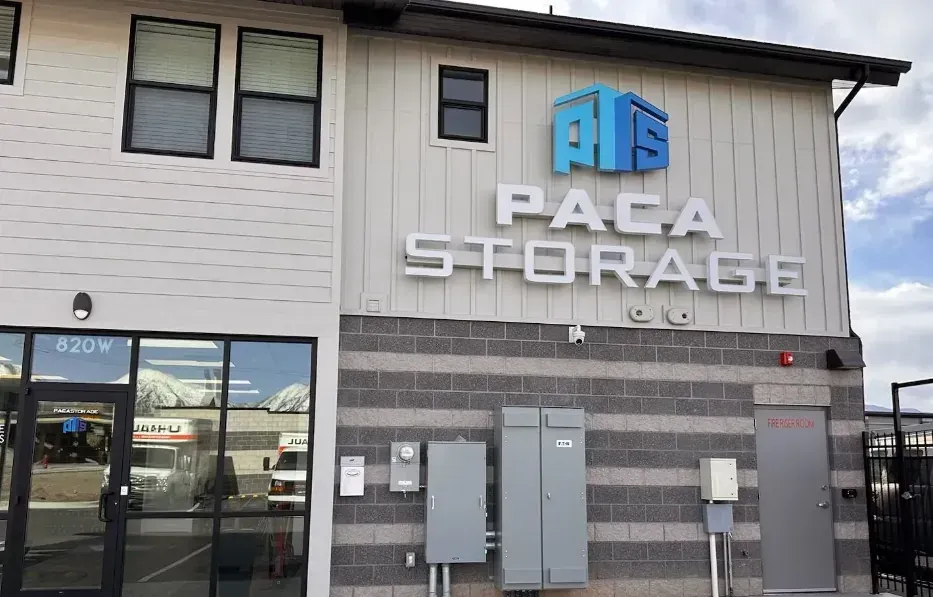
Indoor RV Storage in Utah County
Four walls and a roof between a six-figure motorhome and Utah's sun, hail and winter. Enclosed storage is scarce across the county — here's what it actually protects, and when it's worth paying for.
Ask around for indoor RV storage in Utah County and you'll find the same thing every time: very little of it, mostly full, and priced well above an open space. That's not opportunism — enclosed storage means a heated building large enough to drive a motorhome into, which is expensive to build and consumes an enormous footprint per rig.
Among the indoor rv storage Utah County choices that actually exist, ours sits at the south end of the valley. PACA Self Storage in Payson has a fully enclosed 12.75' × 40' bay at $384 a month, alongside outdoor spaces from $65. This page is about the difference between them — specifically what Utah's climate does to an RV left in the open, and how to work out whether the premium is money well spent on your rig or money wasted.
What an Open Lot Actually Costs Your RV
An RV parked outside isn't idle — it's weathering. The damage is slow, cumulative, and almost entirely invisible until it becomes expensive. These are the mechanisms, roughly in order of what they cost to put right.
Sealant failure, and the water damage that follows
This is the one that ends RVs. Roof and window sealants dry out, shrink and crack under UV and repeated freeze-thaw. Once a seam opens, water gets into the roof structure and walls, and by the time it shows inside, the repair is structural rather than cosmetic. Water intrusion is the single most common reason an otherwise sound rig gets written off.
Roof membrane degradation
Rubber and TPO roof membranes chalk, harden and eventually crack with prolonged UV exposure. A roof replacement is among the most expensive jobs on an RV — comfortably into four figures, often well beyond — and it's driven almost entirely by sun exposure rather than mileage.
Tire aging
RV tires overwhelmingly age out rather than wear out. UV and ozone attack the sidewalls of a stationary tire, producing the fine cracking that makes a tire unsafe long before the tread is gone. A rig that sits outside for years needs tires because of the sun, not the road.
Gelcoat oxidation and decal failure
Fiberglass gelcoat oxidizes to a chalky, dull finish that requires compounding and polishing to correct — a labor-intensive job on a 35-foot surface. Decals fade, crack and peel on the same timeline. Neither affects how the rig drives, and both hammer what it's worth.
Hail
The one that arrives all at once. Hail dents roof panels, cracks skylights and vent covers, and damages the air conditioner shroud — all on the surface nobody inspects until something leaks.
Snow load and freeze-thaw
Accumulated snow adds weight to a roof designed for a driving load, and the melt-and-refreeze cycle works water into any seam that has already started to open. Utah does this repeatedly, every winter.
Payson sits at about 4,700 feet. UV intensity climbs with elevation, so a rig stored here is weathering faster than the same rig would at sea level — and the annual temperature swing runs from roughly 21°F in January to 90°F in July. Both of those work on exactly the materials listed above.
Is $384 Worth It? The Honest Answer
Enclosed costs about $3,800 a year more than our cheapest outdoor space. That is a real gap, and for plenty of rigs it isn't justified. Here's how we'd actually decide.
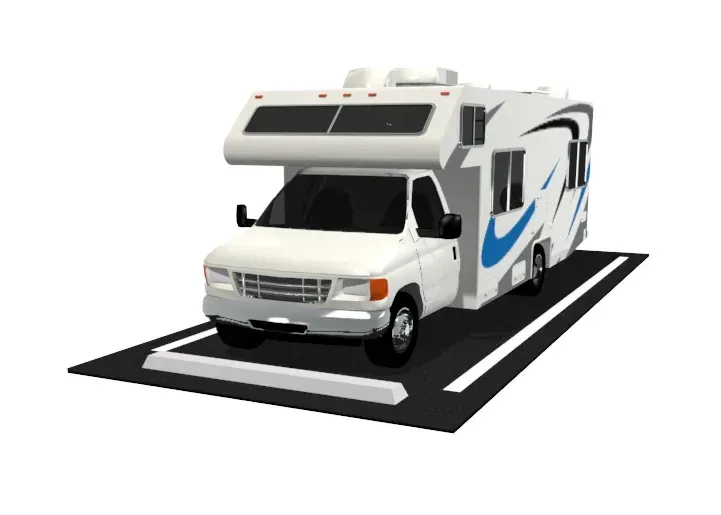
Enclosed makes sense when:
- The rig is worth six figures. On a $200,000 Class A, roughly $3,800 a year is under two percent of value to prevent the specific damage that drives depreciation hardest.
- You intend to sell within a few years. Gelcoat condition, decal integrity and a clean roof are what a buyer or a dealer looks at first. Cosmetic weathering moves the number more than mileage does.
- It's stored long-term rather than seasonally. Nine months a year outside, every year, is where the cumulative damage lives.
- The roof or seals have already been redone. Having paid once for that work, putting the rig back under the same sun is an expensive way to schedule the next one.
- It's a Class B or a high-finish conversion, where a disproportionate share of value sits in paint, decals and exterior finish.
Outdoor is the sensible choice when:
- The rig is a modest travel trailer or older unit. At $65 a month you're getting paved ground, perimeter fencing, cameras and 24/7 access — which is the large majority of the benefit for a tenth of the cost.
- You use it constantly. A rig that's out most of the season isn't accumulating much standing exposure.
- You're diligent with covers and maintenance. A quality cover, resealed seams and tire covers close a meaningful part of the gap for a few hundred dollars.
- The budget matters more than the resale. That's a legitimate position, and we'd rather say so than sell you the expensive option.
Full pricing on every outdoor size is on our RV storage in Payson page.
Indoor and Outdoor, Side by Side
| Enclosed Indoor | Outdoor Paved | |
|---|---|---|
| Monthly rate | $384 | $65–$80 |
| Space | 12.75' × 40' | 12x40, 16x40, 12x50 |
| UV and sun | Eliminated | Full exposure |
| Hail | Eliminated | Exposed |
| Snow load | Eliminated | Exposed |
| Temperature swing | Substantially moderated | Tracks outside |
| Fencing, cameras, lighting | Yes | Yes |
| 24/7 keycode access | Yes | Yes |
| Best for | High-value rigs, long-term, resale-conscious owners | Most trailers and older rigs, seasonal use |
One enclosed bay, 12.75 × 40
Enclosed RV storage is scarce across Utah County. Call to check availability.
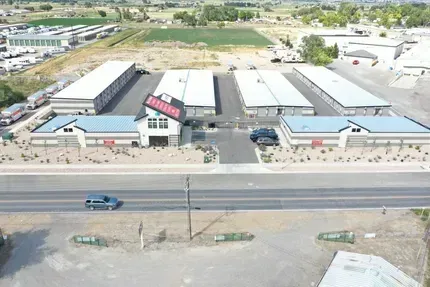
Serving Utah County From Payson
People travel further for enclosed storage than for a parking space, because there are so few places offering it. Almost the entire trip is freeway.
We're at 820 W Utah Ave, one minute from I-15 Exit 250 at the south end of Utah County. Approximate drives:
- Salem — about 5 minutes
- Spanish Fork and Santaquin — about 10 minutes
- Elk Ridge and Woodland Hills — about 10 minutes
- Mapleton — about 15 minutes
- Springville — about 18 minutes
- Provo — about 22 minutes
- Orem — under half an hour
North Utah County — Lehi, American Fork, Pleasant Grove — is a longer run, but it's a run people make, because enclosed capacity anywhere in the county is limited and a rig you store once and collect twice a season doesn't care much about twenty extra minutes. It's a different calculation from a unit you visit weekly. Drive times from every nearby town are on our storage units near me page.
If you're coming from further afield or passing through, RV storage near I-15 covers the highway logistics.
The Enclosed Bay: What Fits
The bay is 12.75 feet wide by 40 feet deep — wider than our standard 12-foot outdoor spaces, which matters for rigs with slide-outs or wide bodies.
- Class A motorhomes up to 40 feet overall.
- Class C motorhomes and larger camper vans with room to walk around.
- Fifth wheels and travel trailers up to 40 feet including the hitch.
- Boats on trailers, where the same UV and weather arguments apply to gelcoat and upholstery.
- High-value or classic vehicles where enclosure matters more than floor area.
Measure your rig's overall length — bumper to bumper, including the hitch, spare and any rear-mounted rack — before booking. A "38-foot" coach is frequently over 40 feet in reality, and 40 feet is the practical limit. Our on-site manager can confirm in a minute whether yours will work.
Also worth knowing: boat storage and vehicle storage use the same spaces, and if you need enclosed storage for gear and household items alongside the rig, storage units start at $67.
Location
PACA Self Storage
820 W Utah Ave
Payson, UT 84651
Phone
Office Hours
Monday–Saturday
9:30 a.m.–6:00 p.m.
Closed Sunday
Gate Access
24 hours a day, 7 days a week
for all tenants, with a personal keycode
Indoor RV Storage FAQs
How much is indoor RV storage in Utah County?
Our fully enclosed 12.75' × 40' bay is $384 a month, month-to-month with no long-term contract. Open-air paved spaces at the same facility run $65 to $80. Enclosed capacity is limited across Utah County generally, so availability is worth checking by phone rather than assuming.
What size RV fits in the enclosed bay?
The bay is 12.75 feet wide by 40 feet deep, which suits Class A and Class C motorhomes, larger camper vans, and fifth wheels or travel trailers up to 40 feet overall. It's wider than our standard 12-foot outdoor spaces, which helps with slide-outs and wide bodies. Measure bumper to bumper including hitch, spare and rear racks — 40 feet is the practical limit.
Is indoor RV storage worth the extra cost?
It depends on the rig. Enclosed runs about $3,800 a year more than our cheapest outdoor space — under two percent of value annually on a $200,000 coach, and easily justified if you intend to sell within a few years, since gelcoat, decals and roof condition are what buyers assess first. On a modest or older travel trailer it's usually not justified: a paved, fenced outdoor space at $65 gets you most of the benefit for a tenth of the cost.
What does the Utah sun actually do to an RV?
Several things at once. Roof and window sealants dry, shrink and crack, which lets water into the structure — the most common reason a sound rig gets written off. Rubber and TPO roof membranes chalk and harden. Fiberglass gelcoat oxidizes to a dull chalky finish, and decals fade and peel. Tires develop sidewall cracking from UV and ozone and age out before the tread wears. Payson sits at about 4,700 feet, and UV intensity increases with elevation.
Does indoor storage protect against hail?
Yes, completely — that's one of its clearest advantages. Hail dents roof panels, cracks skylights and vent covers and damages air conditioner shrouds, all on the one surface owners rarely inspect. It's also damage that arrives in a single afternoon rather than accumulating slowly, so no amount of diligence with covers reliably prevents it outdoors.
Do I still need to winterize an RV stored indoors?
Yes. Enclosure removes UV, precipitation, hail and snow load and substantially moderates temperature swings, but you should still drain the water system or treat it with RV antifreeze, add fuel stabilizer, deal with the battery, and remove all food. Never assume a building means no freeze risk. Follow your manufacturer's guidance — the full checklist is on our RV storage page.
Is the enclosed bay heated or climate controlled?
The bay is a fully enclosed building — four walls and a roof — which removes sun, hail, precipitation and snow load entirely and moderates temperature swings considerably compared with an open lot. If conditioning specifics matter for how you plan to store your rig, call the office and we'll tell you exactly what applies to that space.
Why is indoor RV storage so hard to find in Utah County?
Because indoor rv storage Utah County wide is expensive to provide. Enclosed storage means a building tall and long enough to drive a motorhome into, and each rig consumes an enormous footprint that could otherwise hold a dozen standard units. Most facilities offer none at all, and those that do typically have a handful with a waiting list. That scarcity is also why people routinely drive from further north to reach it.
Can I store a boat or another vehicle in the indoor bay?
Yes. The same arguments apply to boats — gelcoat oxidation, upholstery, and weather exposure — and to classic or high-value vehicles where enclosure matters more than floor area. Current registration and insurance are required for anything stored on the property.
How far is your facility from Provo or Orem?
Provo is roughly 22 minutes and Orem is under half an hour, almost entirely on I-15 to Exit 250. North Utah County — Lehi, American Fork, Pleasant Grove — is a longer run, but people make it, because enclosed capacity anywhere in the county is limited and a rig you drop off once and collect twice a season isn't sensitive to twenty extra minutes.
Out of the sun, out of the hail
Fully enclosed RV storage in Utah County, 12.75 × 40, month-to-month.





